Natura

Hot flushes, poor sleep, mood swings, less strength or desire: from midlife onwards many people notice that something is changing. Sex hormones are often behind it, but not always. This article explains in general terms how oestrogen, progesterone and testosterone are made, what happens during the menopause, what studies show about hormone therapy and which lab values are usual.
Hormones as a life phase, not just a lab value
The menopause is not an illness but a transition. In women it usually starts with changes in the cycle; the menopause itself is the last menstrual period and is determined in retrospect after twelve months without bleeding. In men, testosterone falls slowly with age, without a fixed point in time.
These years often coincide with other changes: children become independent, parents need support, roles shift at work. In holistic medicine we therefore look at body and life phase together. From the practice’s experience, many people find it helpful to look at both: the values and the question of what this phase means in their own life. This is a view drawn from our work with people, not a proven model.

The cascade: from cholesterol to oestrogen, testosterone and cortisol
All sex hormones and cortisol come from the same starting material, cholesterol. The first step to pregnenolone takes place in the mitochondria. From there the pathway branches: to progesterone and further to cortisol in the adrenal gland, or via DHEA to testosterone and from there, with the enzyme aromatase, to oestradiol.
- Cholesterol → pregnenolone
- first step in the mitochondria
- Aromatase
- converts testosterone into oestradiol, also in fat tissue
- Adrenal gland
- makes cortisol and DHEA
- After the menopause
- oestrogen is mainly still produced in fat tissue
The feedback loop
1. GnRH
2. FSH, LH
3. sex hormones
4. hormones slow FSH / LH
When hormone production in the ovaries declines, FSH and LH rise. A high FSH can therefore point to the menopause; during the transition, however, it fluctuates strongly.
Stress and sex hormones: the longer the stress, the stronger the brake
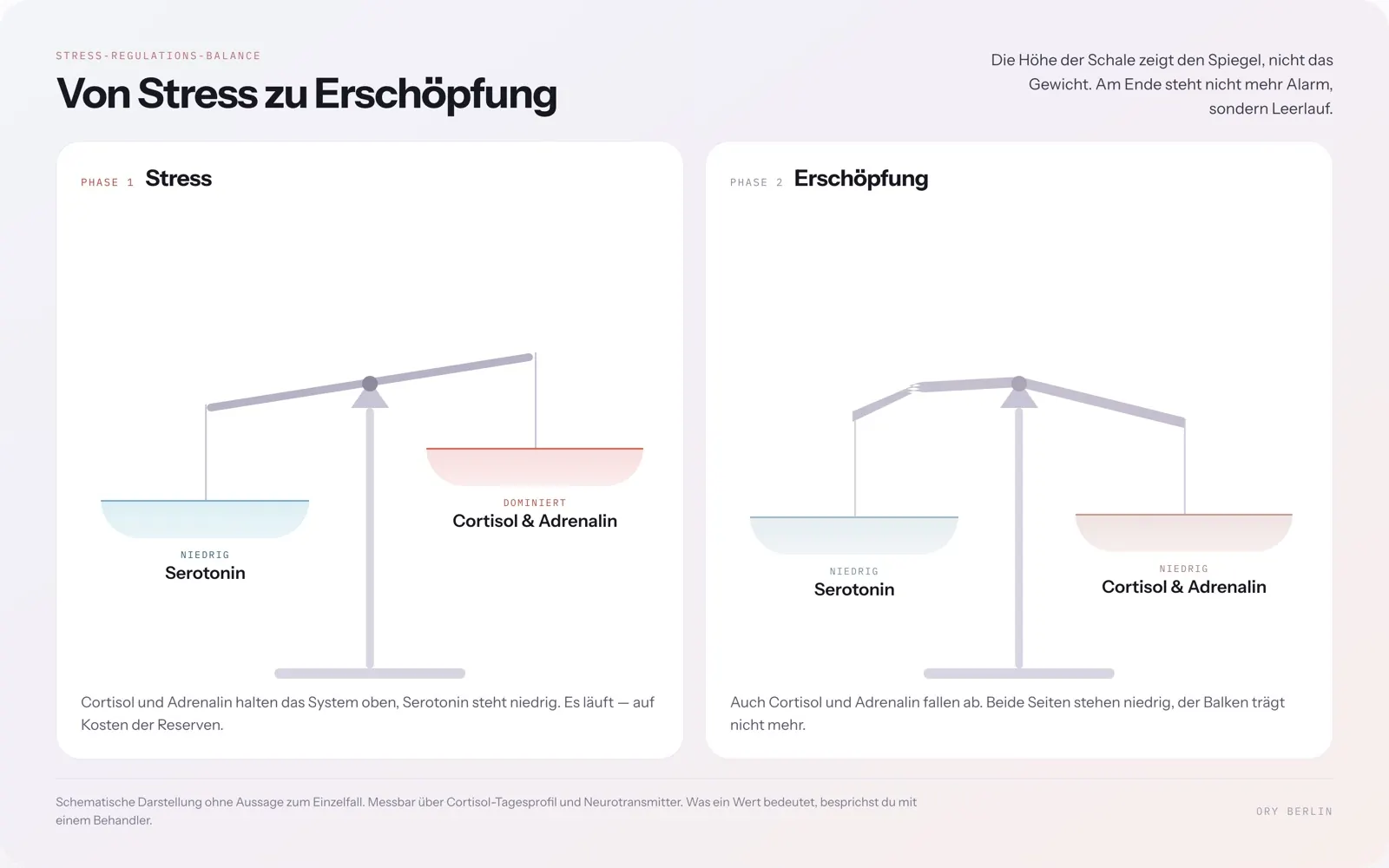
Stress hormones and sex hormones are linked through the brain. With persistent stress, the hypothalamus releases more CRH and the adrenal gland produces more cortisol. CRH and cortisol slow the GnRH pulse generator in the hypothalamus. The pituitary then sends less FSH and LH, and the ovaries and testes produce less oestrogen, progesterone and testosterone. This applies to women and to men.
1. more cortisol
2. slows GnRH
3. less FSH, LH
A well-known example is the absence of periods with severe stress, weight loss or a great deal of exercise, so-called functional hypothalamic amenorrhoea (Endocrine Society guideline 2017). In men, persistent stress can lower testosterone levels. Many details of the mechanism come from animal studies; in humans the link is described, but how strongly it acts varies from person to person (review 2025).
For our work this means: looking only at hormone values in hormonal complaints easily overlooks the brake upstream. That is why sleep, strain and recovery are part of the conversation, more in our article on stress and cortisol.
What the hormones do in the body
| Acts on, among other things | With less of it, there can be | |
|---|---|---|
| Oestrogen | cycle, bones, blood vessels, skin and mucous membranes, brain | hot flushes, dry mucous membranes, sleep problems and bone loss |
| Progesterone | second half of the cycle, pregnancy, tends to be calming | a more irregular cycle and more restless sleep |
| Testosterone | muscles, bones, desire, drive, blood formation | less strength, desire and drive, in women too |
| Cortisol | stress response, blood sugar, inflammation | with chronic stress, an influence on the balance of the other hormones (<a href="/en/gesundheitliche-beschwerden/stress-cortisol-dauerstress-koerper">stress and cortisol</a>) |
The symptoms are unspecific and often have other causes, for example the thyroid (thyroid guide), iron deficiency or lack of sleep.
What studies show about hormone therapy
Women. According to the position statement of the North American Menopause Society, hormone therapy is the most effective treatment for hot flushes and prevents bone loss. For women under 60 or within ten years of the menopause, the benefits usually outweigh the risks when symptoms are bothersome. Starting later carries higher risks for heart disease, stroke, thrombosis and dementia (NAMS position statement 2022). For German-speaking countries there is a dedicated guideline of the professional societies (S3 guideline peri- and postmenopause).
Men. In the large TRAVERSE study with more than 5,000 men aged 45 to 80 with low testosterone and symptoms, testosterone did not lead to more major cardiovascular events than placebo. Pulmonary embolism, atrial fibrillation and kidney injury were more frequent. The study chair stressed that the results do not justify widespread prescription to ageing men (summary by the American College of Cardiology).
Hormone preparations require a prescription, including so-called bioidentical hormones. Whether hormone therapy is an option is decided by a doctor after weighing benefits and risks.
Which lab values are usual
- FSH and LH: signals from the pituitary; they rise when the ovaries produce fewer hormones.
- Oestradiol and progesterone: depend on the day of the cycle; before the menopause the timing of the blood draw matters.
- Testosterone and SHBG: in men usually measured in the morning, because the value falls during the day.
- DHEA-S and cortisol: indications of adrenal function.
- Saliva tests: are offered, but their validity is disputed. An analysis of more than 1,200 women found that salivary oestradiol reflects the cycle phase poorly (Strathclyde 2023). We discuss beforehand which question a test is meant to answer.
The reference range comes from the laboratory. We do not set our own limits; we show the laboratory’s range and discuss what it can mean in your case. Background on testosterone is in our article testosterone deficiency, on the balance of oestrogen and progesterone under oestrogen dominance.
When to see a doctor promptly
- Bleeding after the menopause
- Very heavy or very long periods
- Lumps or changes in the breast
- Marked low mood or thoughts of harming yourself
- Sudden pain or swelling in one leg, shortness of breath
- In men: a lump in the testicle, breast enlargement
How we proceed at Natura Heilpraxis
We begin with a conversation about symptoms, life phase and goals and decide together which values fit the question. You are welcome to bring existing results. We do not prescribe prescription-only medication, including hormone preparations; hormone therapy belongs in medical hands. If you would also like to sort out this life phase inwardly, you can find support in mental coaching. An overview of laboratory services is on the page Laboratory Diagnostics, background on metabolic pathways at Understanding Biomarkers and in the reference work ORY Biomarker. Our discussion does not replace medical diagnostics.
Sources
- The North American Menopause Society: The 2022 hormone therapy position statement. Menopause 2022. PubMed
- Lincoff A. M. et al.: Cardiovascular Safety of Testosterone-Replacement Therapy (TRAVERSE). N Engl J Med 2023. ACC summary
- Arslan R. C. et al.: Not within spitting distance: salivary immunoassays of estradiol have subpar validity for predicting cycle phase. 2023. Full text
- Gordon C. M. et al.: Functional Hypothalamic Amenorrhea: An Endocrine Society Clinical Practice Guideline. J Clin Endocrinol Metab 2017;102(5):1413–1439. Full text
- Reproduction Under Siege: How Chronic Stress … Neuroendocrinology 2025. Karger
- DGGG, SGGG, OEGGG: S3 guideline peri- and postmenopause – diagnosis and interventions (AWMF 015-062). AWMF
Frequently asked questions
How do I notice that the menopause is starting?
Often first through changes in the cycle, later through hot flushes, sleep problems or mood swings. The menopause is determined in retrospect after twelve months without bleeding.
Can the menopause be detected in the blood?
Only to a limited extent. A high FSH can be an indication, but values fluctuate strongly during the transition. Age, cycle and symptoms usually count more than a single value.
Do men go through a menopause too?
Not in the same form. Testosterone falls slowly with age. Whether symptoms are related is clarified through conversation, examination and values measured in the morning.
What are sex hormones made from?
From cholesterol. Via pregnenolone come progesterone and cortisol, and via DHEA testosterone, which the enzyme aromatase converts into oestradiol.
Is hormone therapy dangerous?
That depends on type, dose, duration, age and timing of the start. For women under 60 or within ten years of the menopause with bothersome symptoms, professional societies say the benefits usually outweigh the risks. The decision is made by a doctor.
Are bioidentical hormones freely available?
No. So-called bioidentical hormones also require a prescription and belong in medical hands.
Are saliva hormone tests meaningful?
That is disputed. An analysis of more than 1,200 women found that salivary oestradiol reflects the cycle phase poorly. We discuss beforehand which question a test is meant to answer.
Does stress lower sex hormones?
Persistent stress can slow the production of sex hormones: CRH and cortisol dampen the GnRH signal in the brain, so FSH and LH fall and with them oestrogen, progesterone and testosterone. This applies to women and men; how strongly varies from person to person.
Does stress play a role?
Cortisol and the sex hormones come from the same starting material and influence each other. Chronic stress can affect the balance. More in our article on stress and cortisol.
All questions & answers in the guide →
Professionally responsible: Yesha Karmeli, naturopathic practitioner (Heilpraktiker), Natura Heilpraxis Berlin. This text provides general information and does not replace individual advice.