
 Natura
Creativity is the highest human power – and the first one the body cuts when it starts calculating for survival. About the temple that stands in a time that does not supply it, about cascades instead of single substances, and about the point from which self-realisation becomes possible at all.
Download the article as PDF (in German, 11 pages)
There is a power in people that stands above all others: the creative one. The ability to realise oneself. Not to function, but to create. Not just to live, but to blossom. And there is one property of this power that is rarely talked about: it is the first to go.
Anyone talking about the illness of our time today talks about stress. About exhaustion, poor sleep, lab values out of range. This article takes the opposite route. It does not start with the symptom but with what is lost first – and works its way back from there to the connections in the body where something can be changed.
Principle 1: Creativity is the first thing to be cut when resources run short
Self-realisation is the highest expression of what a person can be. In the body’s budget, however, it comes last. Whatever serves survival is served first: heartbeat, breathing, temperature, wakefulness, alertness. Anything beyond that is surplus – and surplus is what gets cut in lean times.
This explains an experience almost everyone knows and hardly anyone sees as physical: the ability is not gone, the access is. The idea still comes, but it is no longer followed. The evening is free, but there is nothing left to fill it. We run, we deliver, we keep going. We all function. And it is precisely in this mode that what really makes us who we are disappears.
Principle 2: The body is a temple – in a time that does not supply it
A temple is not simply lived in, it is maintained. It needs material, care and rest, and it does not fall apart in a day, but over years in which nobody looks. This is exactly what the modern world puts to the test: deficiencies, because we eat more densely and there is less in it. Constant stress that has no end and is therefore never recognised as strain. Overload from stimuli, appointments, light at the wrong time, and sleep that becomes a leftover.
None of these points stands out on its own. Together they shift the foundation on which everything else rests. The body keeps working – it just increasingly runs on reserves.
The temple needs to be supplied. Today more than before, not less.
Principle 3: A plant under pressure drops its blossom – never its root
Imagine a plant that is growing. Root, stem, leaves: that is the base. The blossom is the highest step, the ability to realise itself. And from the blossom come the seeds – the fruit of all the growth.
If the soil is exhausted, or water or light is missing, the plant drops its blossom. It sacrifices its highest in order to secure its bare minimum. That is not a disease, that is budgeting. The plant is not damaged, it is in survival mode – and it will blossom again as soon as the base allows it.
It is the same with people. Creativity goes first because, biologically, it is the most expensive. Then patience goes, then joy, then sleep. And because all of this happens slowly, at some point it is taken for character – for age, for a phase, for “that’s just how I am”.
Our work begins at this point: bringing people out of survival mode so that self-realisation becomes possible again. Because realising oneself is the highest power.
Principle 4: No substance works alone – the body calculates in cascades
The story told today goes: take this one remedy and your cells will work again. An active ingredient here, a mitochondria booster there. But a human being is not one substance, nor two. A human being is a chain of processes that build on each other – and a chain has its properties not in its links but in the connections.
That is why we work according to the principle of cascades: according to the connections between the processes in the body. One example that shows the whole route is tryptophan. It starts as an amino acid in food, passes through the gut, and there is a switch. One branch leads via serotonin to melatonin – and thus to sleep. The other branch leads via kynurenine to NAD⁺, the currency of cell repair. Both branches share the same raw material. When the body is under strain, the switch changes and the left branch receives less.
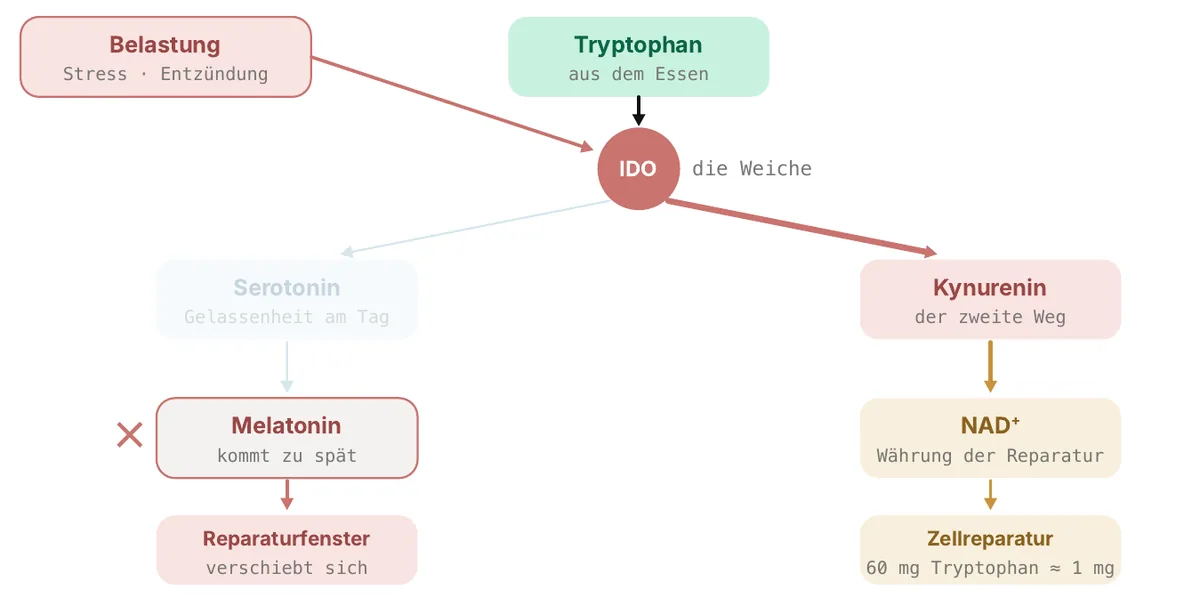
The consequence for practice is a different question. Not: which remedy should I take? But: where is the bottleneck in this chain? Is the raw material missing, a cofactor, is the gut not working, or is the rhythm that sets the pace of the chain off? A cascade can be opened at several points – but only the right one makes a difference. More in Understanding biomarkers.
Principle 5: Below a certain point, the body only administers
Two things decide this. The first is energy: mitochondria that work, nutrients that arrive, sleep in which repair happens. The second is stability: a rhythm that holds, a gut that is sealed, a nervous system that comes back down, blood sugar that is not on a rollercoaster.
Energy without stability makes you driven – there is strength, but it does not last. Stability without energy makes you calm and empty – it holds, but nothing grows. Only when both are sufficient does a surplus arise. And surplus is the precondition for the blossom.
The zero point: enough energy, enough stability
The zero point is not a target value you reach and tick off. It is a threshold. Below it, the body administers its deficit and shuts down everything that is not immediately necessary. Above it, the body can function – and from there, working on health becomes something else: the return of the abilities that had been cut.
The energy axis has a location
In this context, energy is not a feeling but a molecule: ATP. It is produced in the mitochondria, the power plants of the cells, from what we eat and breathe. And for that they need tools – cofactors without which the chain stops: B vitamins, magnesium, iron, coenzyme Q10. If one of them is missing, it is not a little energy that is missing. Energy is missing for everything that comes after: detoxification, repair, sleep – and in the end the blossom.
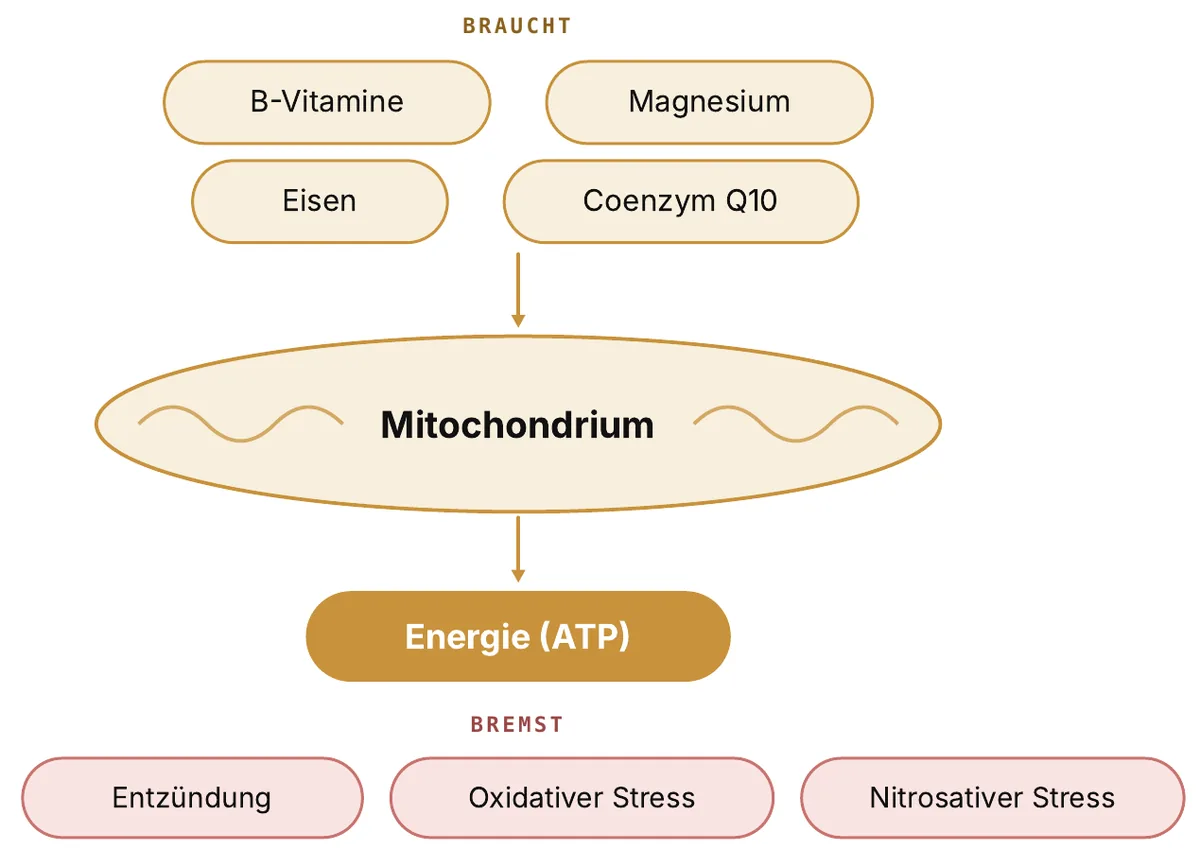
The second half of the picture is the more important one. The same power plants can be slowed down – by inflammation, by oxidative and nitrosative stress. That is why supply alone often changes nothing: you cannot refill what is being used up at the same time. Only when both are looked at together does the energy axis make sense.
- How you notice the zero point: not by a value, but by the fact that strain costs something again and is then over. The morning needs no push. A free evening is used, not endured.
- Why single measures fail: a remedy works within the cascade, not next to it. If the second axis is missing at the zero point, the first one fizzles out – and it looks like an ineffective remedy, when in fact a foundation was missing.
The zero point over time: how people get there – and out again
The field above says what the zero point consists of. It does not say how someone gets there and how they get out again. For that you need the second view: the one over time. In the practice it is the actual working model – the zero-point method.
Three sources push a person below the threshold, and they work together:
- Old rhythms from one’s biography. What the body learned early keeps running. Ingrained patterns that once made sense belong to a life that no longer exists. They create stress without any visible cause – and that is exactly why people look for the cause outside.
- Unresolved conflicts. What is not finished stays on standby in the background. Standby costs, day and night, even when nobody thinks about it.
- Deficiency from the modern world. Too little of what the chains need – the temple from principle 2.
Together they add up to strain. Strain is not the same as exhaustion; it is what precedes it. And it shows first where the surplus used to be.
The zero point is not a low point you suffer, but a transition: the point at which a body finds its way out of constant tension and regains its ability to regenerate. The order afterwards is not arbitrary – first energy into the cells, then the nervous system and sleep, and only then detoxifying and letting go. Detoxification itself costs energy; putting it first takes away from the body what it would need for it.
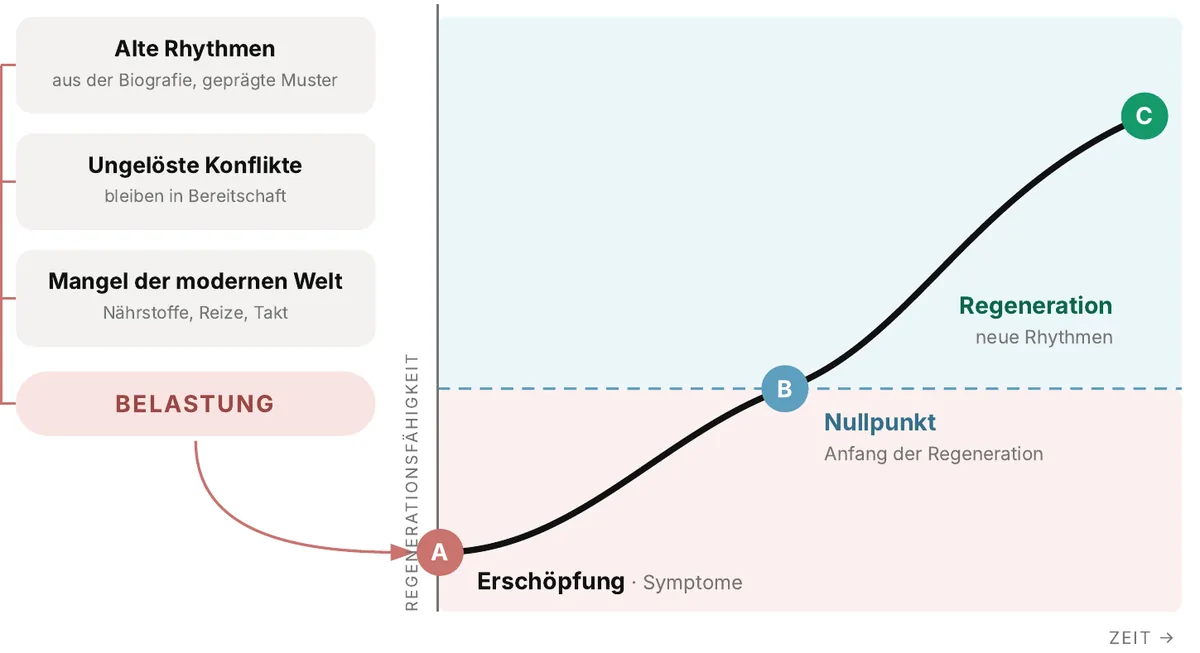
What emerges afterwards is not the old rhythms, repaired. They are new ones. That is the difference between repair and transformation – and it concerns three levels at once:
- Physical: energy, digestion, sleep, rhythm. The measurable – and what gives way first.
- Emotional: what no longer needs to be held on to. Letting go is easier when the body is well – which is why it does not come first.
- Mental: clarity, decisions, looking ahead. What is not available in a state of alarm.
Balance is not a state of rest, but a moving equilibrium between tension and recovery. Transformation is what becomes possible when this equilibrium holds.
Heaven and earth: the connection a person needs
Above the zero point a second question becomes important, and it is not a medical one. A person stands between two ends. Above, the connection to oneself: inspiration, spiritual strength, meaning, new creativity. Below, the earth: healthy food, a healthy body, enough nutrients, a rhythm that carries. Both ends belong together. What runs between them is not a side issue – it is health itself.
If the lower end loses its hold, the upper one has nothing to pull on: the meaning is still there, but it no longer carries anyone. If the upper end is missing, what remains is a well-supplied body with no reason to blossom. Both happen, and from the outside both look like exhaustion.
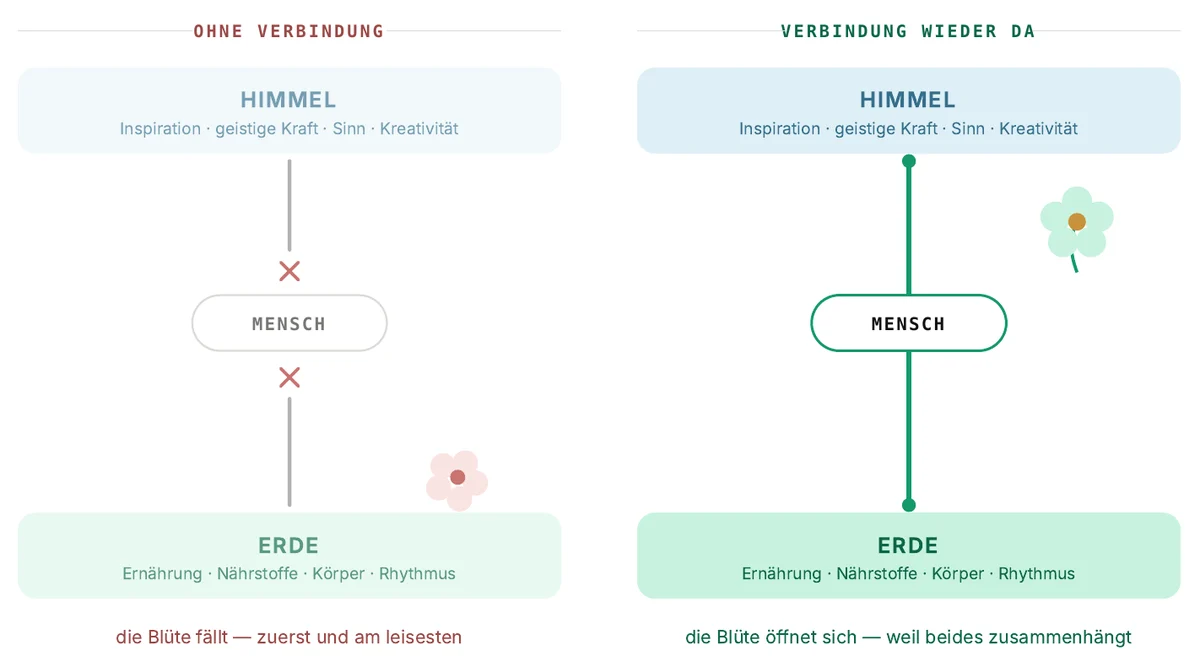
Exhaustion first takes away sensuality, then meaning. Health gives both back – and from meaning and sensuality together, creativity arises.
Masks: the illusion that poses as connection
The connection upwards has an opponent today, and it looks like the opposite. Social media promises closeness and delivers comparison. Instagram shows life, LinkedIn shows careers, and both show only one half of it: the shining one. What is rewarded is imitated – and so a medium turns into a demand. You are supposed to be someone.
A mask is not harmless because it is invisible. It is work. It has to be held, it has to stay consistent, it must not tear – and this holding keeps running in the background, even at night. That puts it in the same column as the unresolved conflict and the old rhythm: a strain with no cause you could show anyone.
And it hits exactly the power this article is about. A blossom cannot be faked. Self-realisation means realising a self – not serving a role that works. Whoever shows themselves the way they want to be seen receives approval for something they are not; that is the loneliest form of attention there is.
Authenticity is not a trait but a permission: to dare to be yourself – and to allow it.
Part of this is something the platforms have no format for. A person goes through processes of transformation. There are phases in which nothing shines, because something is ending, coming loose or has no name yet. These phases are not the pause between the presentable ones – they are the phases in which something actually changes. Whoever may only show the bright half has to hide the half in which they grow.
That is why this belongs here and not in another text: working on energy and stability creates the foundation – but what it is used for decides whether it becomes a blossom or just another, better-supplied role.
Health as something natural again
This shows what a prevention programme should achieve, and what not. It is not a collection of remedies. It is work on the foundation: looking at where the cascades stand, finding the bottleneck instead of guessing it, building energy and stability together, and giving the body the time in which it repairs itself.
The longevity prevention programme of Natura Heilpraxis is meant as exactly this base – not as an add-on to an exhausted everyday life, but as the ground beneath it. The goal is unspectacular and therefore honest: that health becomes something natural again. That the body can do the work it does best anyway. And that the power that went first comes back.
Practice and project: where this takes place
This article comes from a practice and from a project. They belong together: one is the place where we work with people, the other the tool that makes visible what we want to talk about.
- Natura Heilpraxis, Berlin-Grunewald: a naturopathic practice for diagnostics, prevention, therapy and coaching. The principle behind the work: understanding biology and biography together. From the anamnesis through the zero-point method to the prevention programme – physical longevity support and therapeutic work in one place, including the question of where a life should go.
- ORY Berlin, diagnostics platform: the digital side. Lab analyses with a partner laboratory in Germany, results discussion with a naturopath or doctor, programmes over several months instead of single measurements – and the open reference biomarker.ory-berlin.de, so that a value does not stand alone as a number.
There is also an app. dimedi me brings together what is scattered today on paper, in emails and in memory: appointments, the plan released by the practice, the documents – and, in a later step, lab values over time. It is currently in beta; what it can do is described there, not here.
In this work, holistic medicine means nothing soft. It means the opposite of arbitrariness: measuring precisely and still meaning the whole person – cell and life story, lab value and conflict, rhythm and direction. Longevity prevention is not a promise of extra years. It is work on the years in which you still have plans.
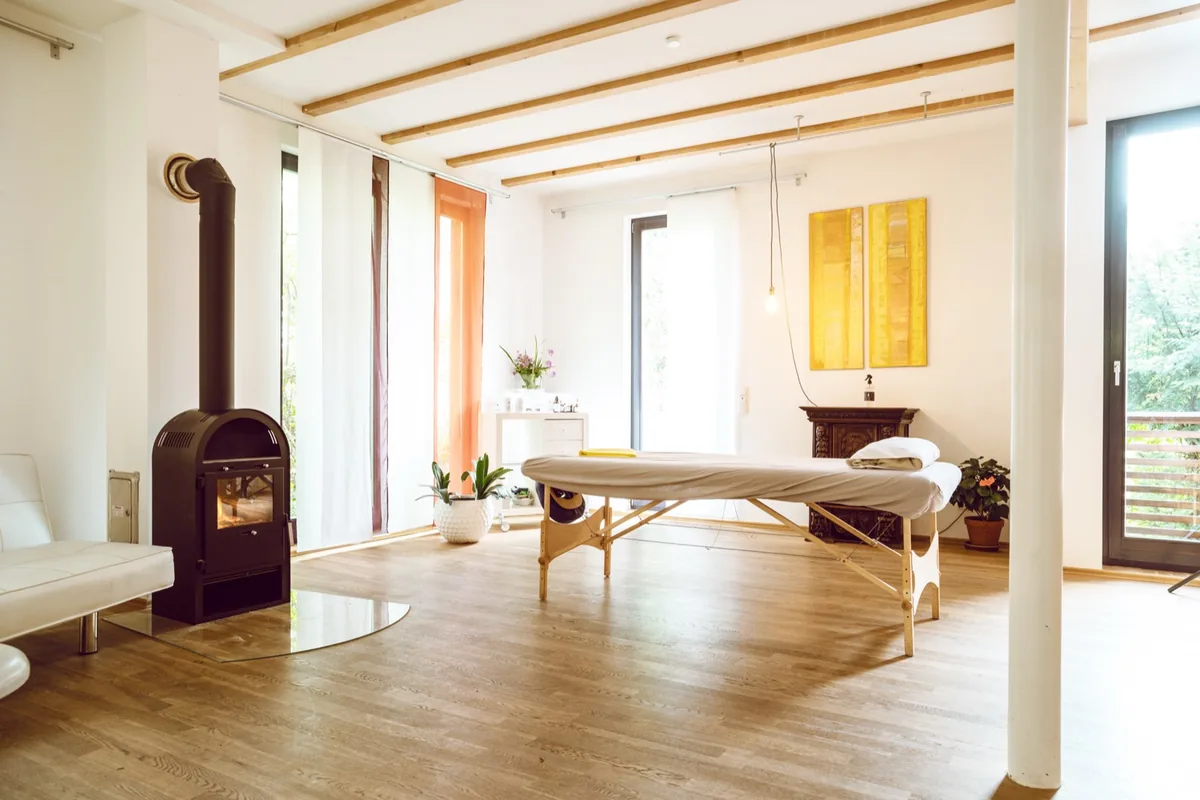
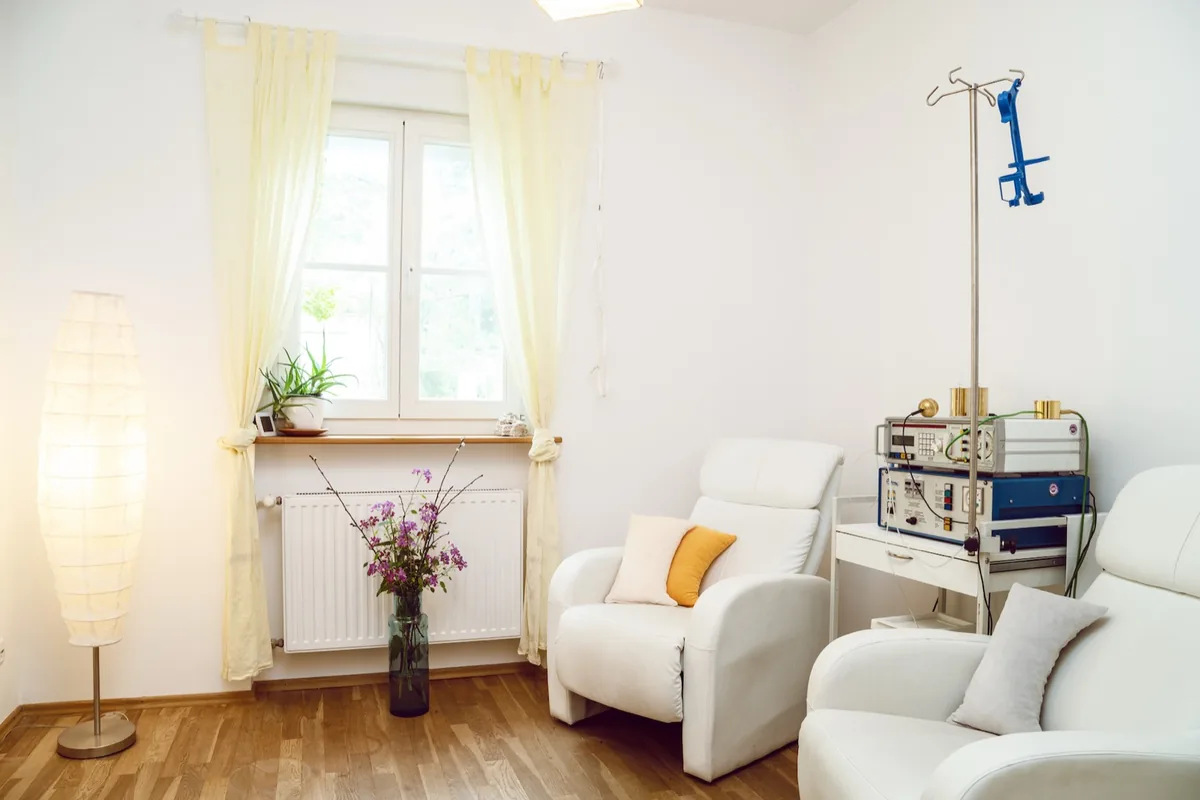
A plant does not blossom because someone teaches it to. It blossoms because the base allows it again.
What this article does not say
- No promise of healing and no diagnosis. The article describes physiological connections. What an individual lacks is shown by an examination, not by a text.
- Blossom and temple are images. They organise an experience; they do not prove it.
- Zero point and heaven–earth are models for understanding, not lab values and not scales.
- The tryptophan cascade is textbook physiology. Direction and order of the pathways are established; the amounts in the diagram are schematic. No finding is derived from it.
- The section on social media is an observation, not a body of research.
- The app is in beta. Lab values over time are announced, not available.
- No recommendation of substances. The cofactors mentioned are textbook knowledge about a metabolic pathway: no dose, no product, no assignment to any person.
Frequently asked questions
Why is creativity lost first under stress?
The body first serves what keeps it alive: heartbeat, breathing, alertness. Creativity belongs to the surplus, and that is cut first when resources are short. The ability remains, but the access is missing.
What is meant by the zero point?
The zero point is a threshold, not a lab value: enough energy and enough stability. Below it the body administers its deficit, above it it can regenerate again. It is the working model of the practice’s zero-point method.
Can I download the article?
Yes, as an 11-page PDF in German with all diagrams. The download link is at the beginning and end of the article.
Professionally responsible: Yesha Karmeli, naturopathic practitioner (Heilpraktiker), Natura Heilpraxis Berlin. This text provides general information and does not replace individual advice.